



ORGANS OF PARIS © 2026 Vincent Hildebrandt HOME ALL ORGANS



B2
Before the Revolution
The church had an organ, but no documents survive about
how it was lost before the Concordat. We don't know its
specs. In 1763, it was maintained by Claude Ferrand. This
organ disappeared during the French Revolution, around
1793.
After the Concordat, an accompanying organ built by the
organ builder Larroque was installed in the choir.
1831-1841
Louis Callinet built a new organ. It had no visible pipes, with
30 stops across 3 manuals and a pedalboard. It was placed
behind the high altar, above the sacristy.
1864-1867
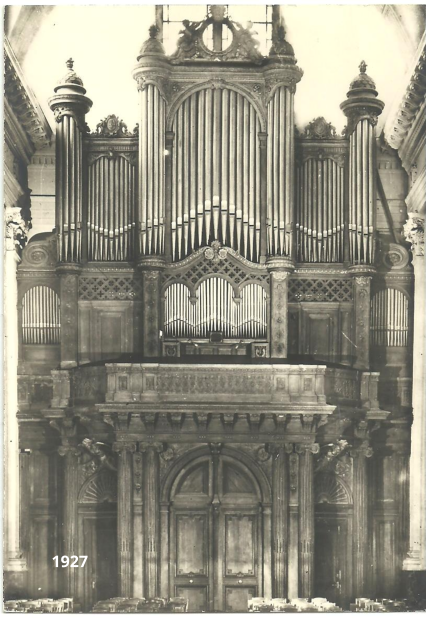
Joseph Merklin was tasked with moving the instrument to
the current gallery, which was made from 18th-century
elements. He completely rebuilt the mechanics,
windchests, and bellows. A few mutation and mixture stops
were also removed.
1910
John-Albert Abbey removed all the mutation stops; the
organ was reduced to 25 stops.
1924
Auguste Convers restored and enlarged the instrument to
32 stops. He changed the keyboard layout (with G0 first).
The Choir organ became enclosed, a Barker lever was
added to the Great, and a tubular-pneumatic action was
installed for the Swell.
1962
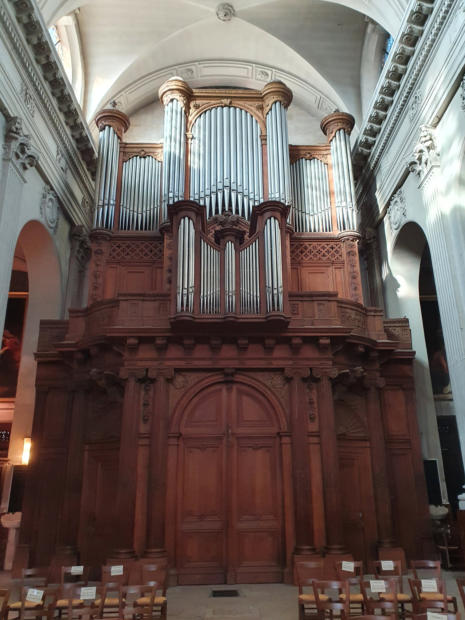
After the bombings on August 26, 1944, which badly
damaged the organ, Alfred Kern rebuilt it in a North
German style. The old case (from 1864) was kept, but its
base was modified (extended by 2.5 m, moving the organ
about a meter from the front wall to improve acoustics),
and a new chair organ case facing the back was added.
Much of Callinet's pipework was retained. The console is in
the center window with a suspended tracker action. The
stop action is electro-pneumatic, allowing two free
combinations.
1973
Modifications by Alfred Kern & Sons.
1991
Overhaul by builder Dominique Lalmand (with a Bach-
Kellner temperament applied).
Around the same time (or shortly after?): On the Great, the
16' Bourdon was replaced by a Quintaton 16', and the
Grosse Tierce by a Flute 4'. On the Pedal, the Trumpet was
replaced by a Bassoon 8', and the Clarion 4' by a Cornet 2'.

The story of Notre-Dame-des-blancs-Manteaux
begins in the 13th century with the erection of a
convent. The church, in classical style, was built in
1668. During the Revolution, as early as 1790,
religious orders were abolished, monks of the White
Mantles expelled, buildings looted and sold (1796
and 1797). The church was reopened to worship after
the Concordat. In 1863, the architect Victor Baltard
added an eighth span to Rue des Blancs-Manteaux.
As a façade, he relocated the portal of the Church of
the Barnabites, demolished during the drilling of the
Boulevard du Palais.
Artistically, the Church of the White Mantles houses a
surprising number of religious paintings in its nave
and its chapel Sainte-Geneviève. It is also home to a
magnificent German Baroque-style preaching pulpit,
acquired by Father Charles-Félix Garenne, parish
priest of the church from 1831 until his death in 1878
and to whom most of the current furniture is owed.



1841 - Louis Callinet (1)
1867 - Joseph Merklin (3a)
1910 - John-Albert Abbey (6)
1924 - August Convers (5)
1968 - Alfred Kern (3)
1973 - Alfred & Daniel Kern (7)
1991 - Dominique Lalmand (6)
IV/43 - mechanical traction
stoplist
Titular organist
Matthieu Odinet
Famous organists in the past: Léonce de Saint Martin,
Georges Guillard, Odile Bailleux.
Parish website
A wonderful instrument
Dominique Merlet, the young titular organist of the
great organ of Notre-Dame des Blancs-Manteaux, has
every reason to be delighted. The brand-new
instrument now sounding beneath the classical vaults
of this church has struck all listeners as one of the most
appealing of its kind. It is a suspended mechanical-
action organ with forty-three stops, distributed over
four manual keyboards—including a positive—and
pedal.
The Strasbourg builder Alfred Kern has produced a
masterpiece of voicing here—indeed, I would say even
surpassing Saint-Séverin—in the brilliance of its colors
and the poetry of its timbres. Supported by an
exceptionally favorable acoustic, this new instrument is
certain to enjoy great success with concert performers
and, no doubt, with recording companies as well.
Xavier Darasse, professor at the Toulouse Conservatory
and a highly accomplished virtuoso, was entrusted with
the public inauguration. He carried it out with well-
judged eclecticism, moving from Sweelinck to
Shostakovich, and from Buxtehude to Messiaen. The
lively freedom of his interpretations may have shocked
some. But it is good, from time to time, for a true
musician—well versed in different styles—to abandon
the excessive neutrality of many traditional
performances and to decide to play Bach as he feels it,
and as he imagines the Cantor himself might have
played.
When this renewing imagination is combined with the
colors of subtle and varied registration, surprise gives
way to admiration for such a personality and for the
way it draws on a wonderful instrument.
Olivier Alain, Le Figaro, 28 June 1968 (Musical column)








Organs of Paris


ORGANS OF PARIS © 2026 Vincent Hildebrandt
B2
Before the Revolution
The church had an organ, but no documents survive about
how it was lost before the Concordat. We don't know its
specs. In 1763, it was maintained by Claude Ferrand. This
organ disappeared during the French Revolution, around
1793.
After the Concordat, an accompanying organ built by the
organ builder Larroque was installed in the choir.
1831-1841
Louis Callinet built a new organ. It had no visible pipes, with
30 stops across 3 manuals and a pedalboard. It was placed
behind the high altar, above the sacristy.
1864-1867
Joseph Merklin was tasked with moving the instrument to the
current gallery, which was made from 18th-century elements.
He completely rebuilt the mechanics, windchests, and
bellows. A few mutation and mixture stops were also
removed.
1910
John-Albert Abbey removed all the mutation stops; the organ
was reduced to 25 stops.
1924
Auguste Convers restored and enlarged the instrument to 32
stops. He changed the keyboard layout (with G0 first). The
Choir organ became enclosed, a Barker lever was added to
the Great, and a tubular-pneumatic action was installed for
the Swell.
1962
After the bombings on August 26, 1944, which badly
damaged the organ, Alfred Kern rebuilt it in a North German
style. The old case (from 1864) was kept, but its base was
modified (extended by 2.5 m, moving the organ about a
meter from the front wall to improve acoustics), and a new
chair organ case facing the back was added. Much of
Callinet's pipework was retained. The console is in the center
window with a suspended tracker action. The stop action is
electro-pneumatic, allowing two free combinations.
1973
Modifications by Alfred Kern & Sons.
1991
Overhaul by builder Dominique Lalmand (with a Bach-Kellner
temperament applied).
Around the same time (or shortly after?): On the Great, the
16' Bourdon was replaced by a Quintaton 16', and the Grosse
Tierce by a Flute 4'. On the Pedal, the Trumpet was replaced
by a Bassoon 8', and the Clarion 4' by a Cornet 2'.

1841 - Louis Callinet (1)
1867 - Joseph Merklin (3a)
1910 - John-Albert Abbey (6)
1924 - August Convers (5)
1968 - Alfred Kern (3)
1973 - Alfred & Daniel Kern (7)
1991 - Dominique Lalmand (6)
IV/43 - mechanical traction
stoplist
Titular organist
Matthieu Odinet
Famous organists in the past: Léonce de Saint Martin, Georges
Guillard, Odile Bailleux.
Parish website
